About Tripotassium EDTA
Description
A high grade of EDTA potassium salt is manufactured by Shiv Chem industries since 1987.We are leading manufacture and Exporter of EDTA potassium salt. EDTA potassium salt is a chelating agent or sequestering agent EDTA potassium salt is a White free flow powder. It is soluble in water.. It is also known as EDTA Tri potassium, diotassium salt EDTA and Ethylene Diamine tetra acetic acid Tri potassium salt, K2EDTA.
Handling
EDTA and its strong solution causes serious irritant to eyes and skin. While handling this product, please wear goggles, gloves, and rubber boots. In case of large spillage first spread soda ash and wash it with plenty of water. In case of injury to skin, wash it water and then wash thoroughly with soap and water. However, looking to the seriousness of each case, medical attention must be obtained.
Storage
Tri potassium EDTA should be stored in a cool dry place. Stored in container made of, or lined with polyethylene, polypropylene.
Packing
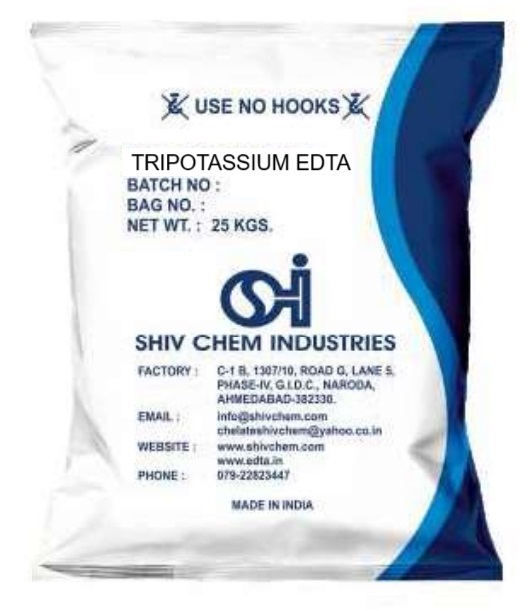
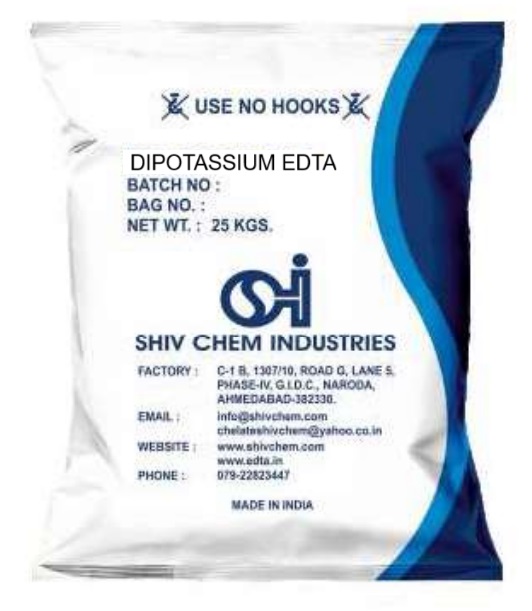
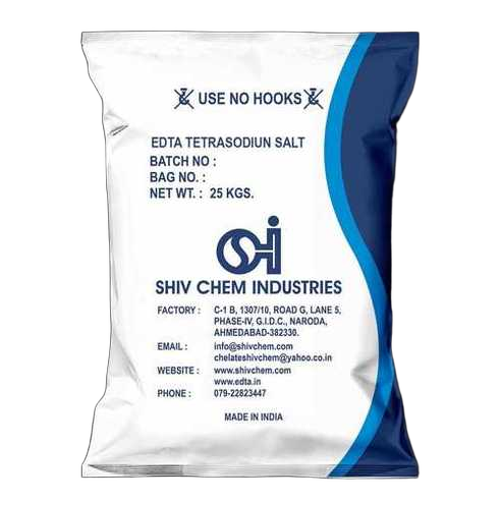
It is packed in 25 Kg HDPE bags/ Paper bag containing polyethylene liner inside, or as par customer's requirement.
Superior Metal Ion SequestrationTripotassium EDTA is widely recognized for its exceptional ability to bind and remove unwanted metal ions from a variety of solutions. This prevents interference by metals such as calcium, magnesium, iron, and copper, ensuring cleaner processes in industries from electroplating to chemical manufacturing. Its chelating strength supports consistent and reliable product quality.
Industrial Applications and Versatile UsageIndustrially, Tripotassium EDTA finds use as a micronutrient supplement and is pivotal in the electroplating industry, where it improves plating bath stability and final product quality. Its ability to remove metals makes it crucial for solution purification. Suitable for use at a pH range of 4.0 to 6.0, it boasts a molecular weight of 404.47 kg and is exported globally from India.
FAQ's of Tripotassium EDTA:
Q: How is Tripotassium EDTA used in the industrial sector?
A: Tripotassium EDTA is primarily used as a chelating agent, binding and removing metal impurities from solutions in various industrial processes. In the electroplating industry, it stabilizes metal baths and enhances product quality. It also serves as a micronutrient in industrial formulations.
Q: What benefits does Tripotassium EDTA provide in electroplating applications?
A: In electroplating, Tripotassium EDTA helps maintain the stability of plating solutions by sequestering metal ions that can otherwise cause defects. This leads to smoother, higher-quality finishes and increases the consistency of the electroplating process.
Q: When should Tripotassium EDTA be used as an impurity remover?
A: Tripotassium EDTA should be used whenever metal contamination from ions like calcium, magnesium, iron, or copper could negatively affect process efficiency or product quality. Its application is especially important in industries requiring high-purity solutions or precise chemical control.
Q: Where is Tripotassium EDTA manufactured and exported from?
A: This industrial-grade Tripotassium EDTA is manufactured and exported by reputable suppliers based in India, serving a broad international market across various industries.
Q: How does Tripotassium EDTA act as an antidote for metal poisoning or as an anticoagulant?
A: Tripotassium EDTA can bind toxic metals such as calcium and lead in cases of metal poisoning, helping to remove them from the body. In medical settings, it is used as an anticoagulant in blood sample tubes to prevent clotting by sequestering metal ions involved in coagulation.
Q: What is the process of using Tripotassium EDTA in solution purification?
A: To purify solutions, Tripotassium EDTA powder is added and dissolved, where it binds to unwanted metal ions, allowing them to be separated or neutralized, resulting in cleaner, contaminant-free liquids suitable for industrial processes.
Q: What purity and pH range does Tripotassium EDTA typically offer?
A: This product is supplied at a high purity level of 99.0% 1.0% and operates effectively within a pH range of 4.0 to 6.0, meeting the quality requirements for industrial applications.

 Call Us:- 08045812142




 Send Inquiry

 Send Inquiry
 Send Inquiry
 Send SMS


 English
 Spanish
 French
 German
 Italian
 Chinese (Simplified)
 Japanese
 Korean
 Arabic
 Portuguese